A simulation-based design of the CEPC fast luminosity monitor detector using 4H-SiC
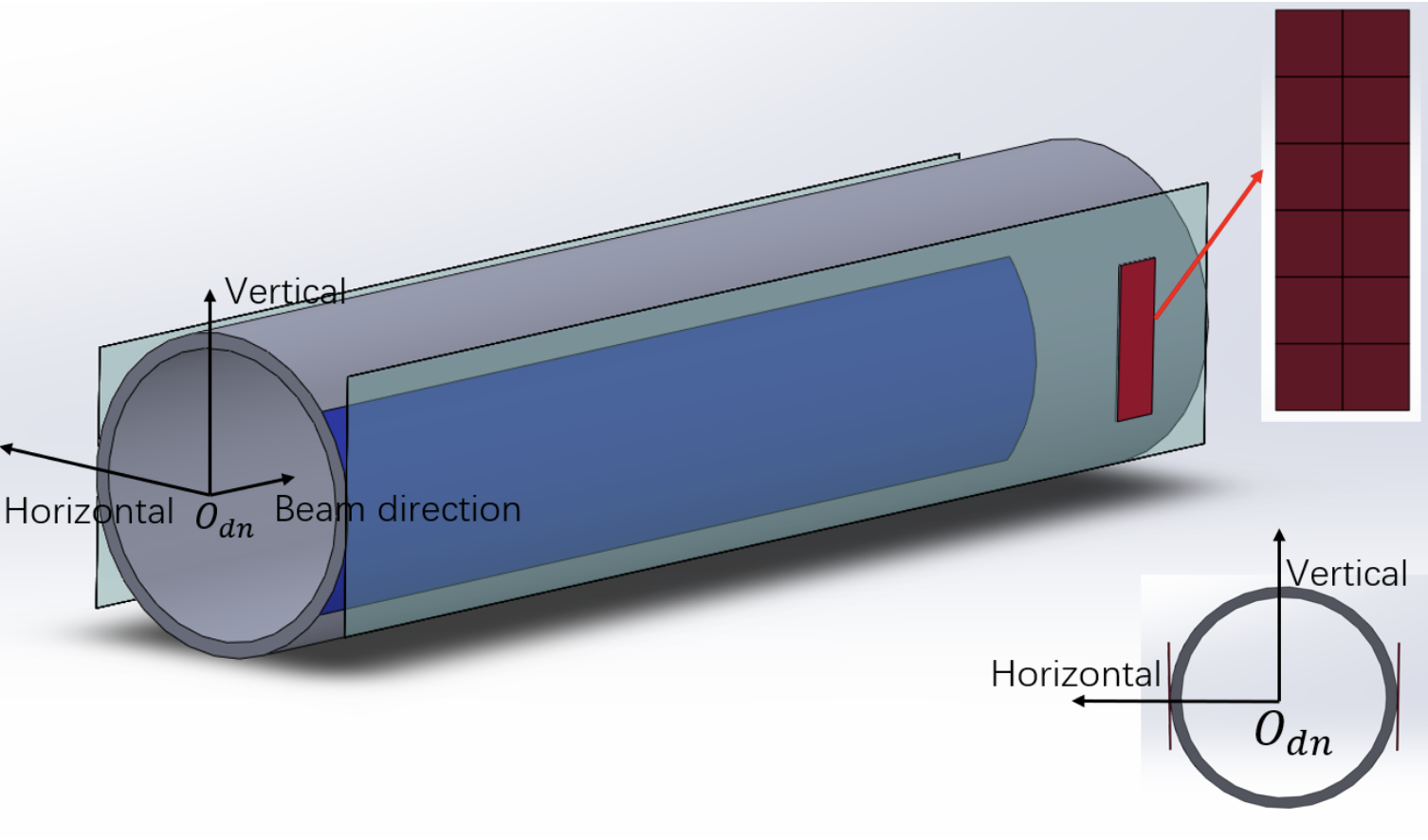
The Circular Electron-Positron Collider (CEPC), a next-generation high-luminosity collider, employs a crab waist scheme to achieve ultrahigh 5 × 1034 cm-2s-1 luminosity at Higgs mode. Owing to the extremely small beam size, the luminosity is highly sensitive to the stability of final focusing elements, where mechanical vibrations (e.g. ground motion) may induce beam offsets and luminosity degradation. To address this, a luminosity-driven dithering system is implemented for horizontal beam stabilization. In this work, we develop an optimized 4H-SiC fast luminosity detector scheme using an array of radiation detectors with picosecond time resolution positioned at critical locations. By using self-development software RAdiation SEmiconductoR (RASER), we optimize the active area of the detector to achieve 2% relative precision at 1 kHz. Furthermore, the RAW SUM exhibits a near-linear correlation with luminosity attenuation, enabling real-time luminosity monitoring.
Further reading: Y. Li, et al., A simulation-based design of the CEPC fast luminosity monitor detector using 4H-SiC, 2026 JINST 21, T02009