Rise Time and Charge Collection Efficiency of Graphene-Optimized 4H-SiC p-i-n Detector
Silicon carbide detectors exhibit good detection performance and have been studied for various detection applications. However, in some applications, the presence of metal is undesirable, such as low-penetration particle detection, UV light detection, and medical dosimetry. A graphene-optimized 4H-SiC detector has been fabricated not only meet the aforementioned detection requirements but also shorten the signal rise time. Its electrical properties, rise time, and the charge collection performance of ¸ particles are reported. The effective doping concentration of the lightly doped 4H-SiC epitaxial layer is about $4.5 \times 10^{13}cm^{−3}$, approaching the limit of the lowest doping level by the silicon carbide (SiC) epitaxial growth technique. The rise time of the graphene-optimized ring electrode (RE) detector is reduced by 24% at 200 V compared to the RE detector. The charge collection efficiency (CCE) of graphene-optimized 4H-SiC p-i-n is 99.22%. When the graphene has been irradiated using 80-MeV proton beam with fluence of $2.1 \times 10^{11} n_{eq}/cm^2$, the irradiation has no significant impact on the rise time and uniformity of the rise time for the graphene-optimized 4H-SiC detectors. This study proves that graphene has a certain radiation resistance. Graphene-optimized 4H-SiC detectors can not only reduce the signal rise time but also improve the uniformity of signal rise time and the stability of charge collection. This research may expand the application of graphene-based 4H-SiC detectors in fields such as low-penetration particles’ detection, high-energy articles’ detection, low-energy heavy-ion detection, medical dosimetry, and transient current technique (TCT) measurement.
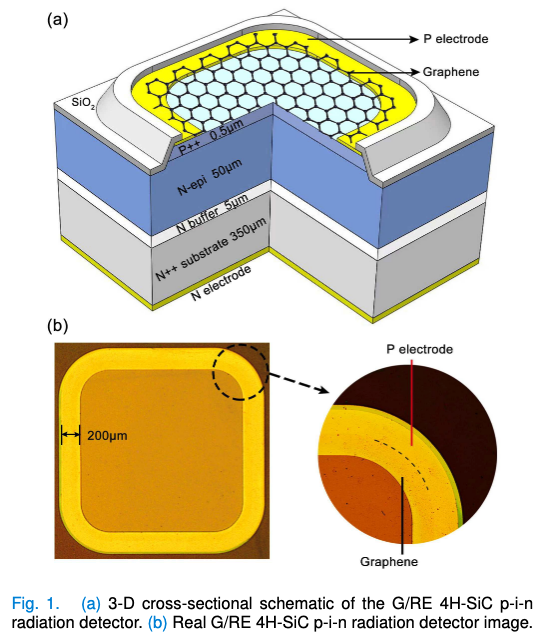
Further reading: Z. Jiang, et al., Rise Time and Charge Collection Efficiency of Graphene-Optimized 4H-SiC p-i-n Detector, IEEE TED VOL. XX, NO. XX, 2026