Radiation Tolerance of Epitaxial 4H-SiC LGAD Under 80-MeV Proton Irradiation
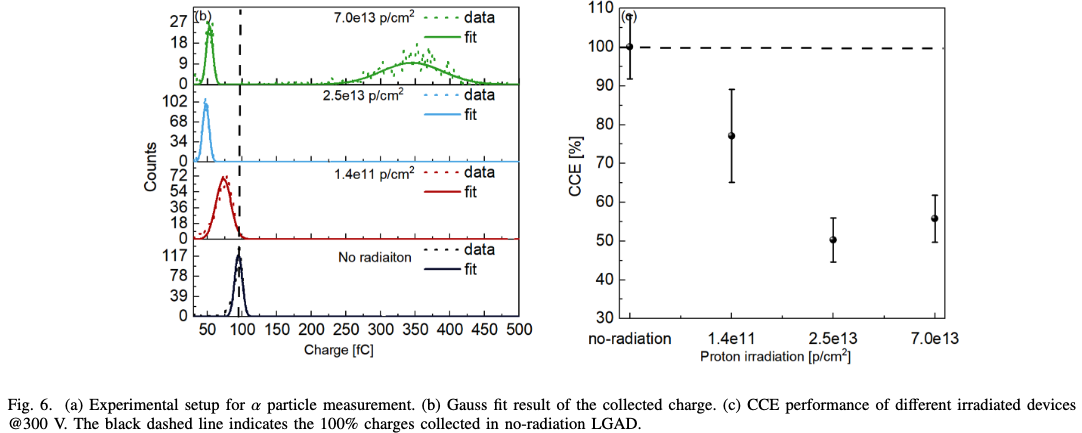
Silicon carbide (SiC) is a promising material for radiation monitoring in harsh environments, due to its low dark current, high breakdown voltage, high thermal conductivity, and radiation hardness. This work investigates a SiC-based low-gain avalanche detector (LGAD), named SICAR, with a gain factor of 2–3, under 80-MeV proton irradiation up to $7.0 \times 10^{13} p/cm^2$. Electrical characterization via current–voltage (I–V), capacitance–voltage (C–V), and α particle injection reveals an increase in threshold voltage and a 2–4 order of magnitude reduction in the leakage current, while charge collection efficiency decreases to about 50.3%. X-ray diffraction (XRD) and capacitance deep-level transient spectroscopy (C-DLTS) were employed to characterize the lattice structure and deep-level defects before and after irradiation. Deep-level defect characteristics were integrated into TCAD simulations to develop an electrical degradation model for SiC LGADs. A linear defect-fluence relationship is established in the model, showing agreement with CV and forward IV characteristics.
Further reading: S. Zhao, et al., Radiation Tolerance of Epitaxial 4H-SiC LGAD Under 80-MeV Proton Irradiation, IEEE TNS VOL. 73, NO. 1, JANUARY 2026