Irradiation study using QA test pieces of ATLAS18 ITk strip sensors with 80 MeV protons
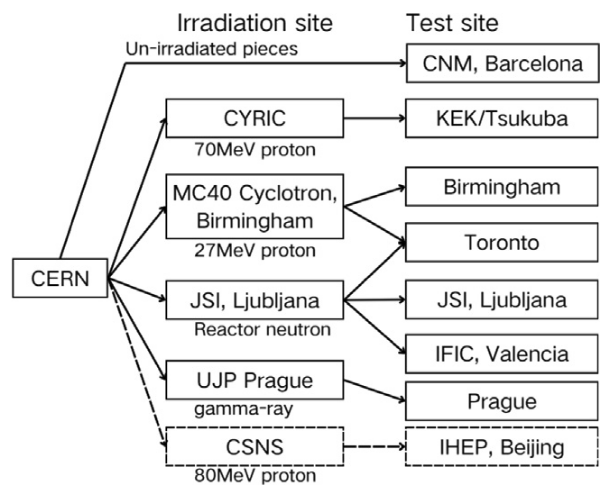
The ATLAS experiment is planning a complete replacement of its inner detector (ID) with a new all-silicon inner tracker (ITk) for the ATLAS Phase-2 upgrade. The ATLAS18 silicon strip sensors are designed to operate up to the integrated luminosity of 4000 $fb^{−1}$, which corresponds to the maximum fluence of $1.6 \times 10^{15}~n_{eq}∕cm^2$ (including safety factor). To enhance the quality assurance (QA) program to monitor the key properties of the sensors, the strip sensor community is considering to include China Spallation Neutron Source (CSNS) as a proton irradiation site and Institute of High Energy Physics (IHEP) as a QA test site. A total of 18 ATLAS18 ITk QA test pieces were irradiated with $6.0\times 10^{14}$, $1.6 \times 10^{15}$, and $2.6 \times 10^{15}~n_{eq}∕cm^2$ protons at CSNS, and measured at IHEP, including IV (leakage current–voltage), CV (capacitance–voltage) and CCE (charge collection efficiency) measurements. The upgraded irradiation setup at CSNS and measurement setup at IHEP are shown in this paper. Irradiated samples were exchanged between IHEP, Ljubljana and Birmingham to cross-check CCE measurements.
Further reading: Y. Huang, et al., Irradiation study using QA test pieces of ATLAS18 ITk strip sensors with 80 MeV protons, Nucl. Instrum. Methods A 1080 (2025) 170707